Prostate Volume Calculator
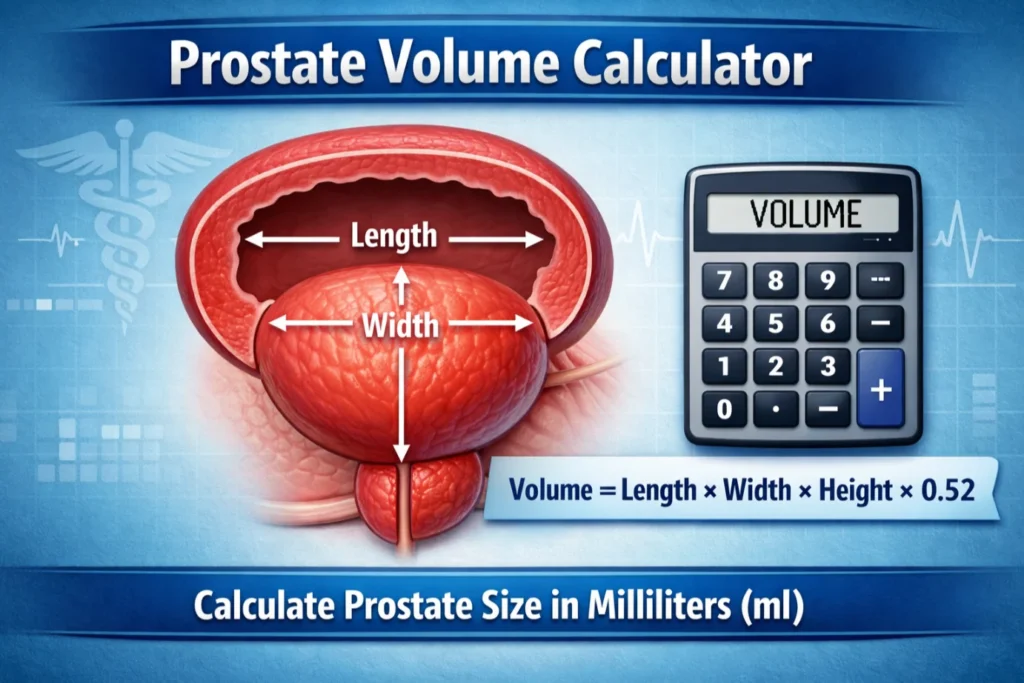
Prostate Volume Calculator Tool
A prostate volume calculator is a practical tool used to estimate the size of the prostate gland based on imaging measurements. Instead of relying on rough assumptions, it provides a structured way to interpret prostate dimensions and convert them into meaningful volume data. This estimation plays an important role in clinical evaluation, especially when assessing urinary symptoms, monitoring prostate enlargement, or supporting treatment decisions. By translating measurements into volume, healthcare professionals gain clearer insight into prostate health without invasive procedures.
Understanding the Prostate Volume Calculation
Prostate volume calculation is based on anatomical geometry rather than guesswork. The prostate is typically approximated as an ellipsoid shape, which allows clinicians to calculate volume using length, width, and height measurements obtained from imaging studies.
These measurements are commonly taken during ultrasound or MRI examinations. Once recorded, they are applied to a standardized mathematical formula that produces a reliable volume estimate. This method ensures consistency across evaluations and helps track
changes over time. Understanding how volume is derived makes the results easier to interpret and prevents misjudgment based solely on symptoms or age.

What is a Prostate Volume Calculation Tool
A prostate calculator is a digital tool designed to simplify the volume estimation process. Instead of manually applying formulas, the user enters measured dimensions, and the calculator instantly generates an accurate volume result. This tool reduces calculation errors and saves time, particularly in clinical or diagnostic settings. It also improves consistency, ensuring that results are comparable across different assessments and follow-up visits. For patients, it helps translate complex measurements into understandable information, supporting clearer discussions with healthcare providers.
How to Use the Free Prostate Volume Calculator Tool
Obtain Accurate Measurements
Begin by collecting prostate measurements through an ultrasound performed by a healthcare professional. You will need height (anterior–posterior), width (transverse), and length (cranio-caudal), all recorded carefully in millimeters.
Enter the Measurement Values
Enter the height, width, and length into the calculator fields provided. The calculation works entirely within your browser, ensuring that no personal or medical information is saved, tracked, or shared during the process.
View the Calculated Volume
Once the values are entered, the calculator instantly displays the prostate volume result. It uses the standard ellipsoid formula (π/6 × height × width × length) and Bullet formulas commonly applied in clinical practice for size estimation.
How to Use the Free Prostate Volume Calculator
Using the Prostate Volume Calculator begins with accurate measurement. Dimensions are typically recorded during an imaging exam and include the prostate’s length, width, and height. Once these values are entered, the calculator applies the standard ellipsoid formula automatically. The output reflects the estimated prostate size, which can then be reviewed in context with symptoms, age, and clinical findings. Accuracy depends on proper measurement rather than repeated calculations, so correct imaging technique remains the most important factor.
Comprehensive Guide to Prostate Volume Calculation Assessment
Prostate volume assessment is not performed in isolation. It is interpreted alongside urinary symptoms, flow studies, and overall prostate health indicators. A single measurement provides a snapshot, while repeated assessments reveal progression or stability. Imaging modality also matters. Ultrasound is commonly used for routine evaluation, while MRI may offer more detailed anatomical insight in complex cases. Each method contributes valuable information when combined with volume estimation. By integrating volume data with clinical context, healthcare professionals can form a more complete and reliable assessment.
Clinical Significance of Prostate Volume Calculator
Prostate volume has direct clinical relevance. An increase in size is often associated with urinary obstruction, symptom severity, and treatment response. Larger volumes may influence decisions related to medication, monitoring frequency, or surgical planning. Volume measurement also helps differentiate between benign enlargement and other prostate conditions. Tracking changes over time allows clinicians to evaluate disease progression and treatment effectiveness. When interpreted correctly, prostate volume serves as a meaningful indicator rather than a standalone diagnosis, guiding informed and balanced clinical decisions.
Measurement Methods
Prostate size assessment depends heavily on how measurements are obtained. Different imaging methods offer varying levels of detail, accessibility, and clinical context. Choosing the right method ensures reliable volume estimation and meaningful interpretation.
Transrectal Ultrasound (TRUS)
Transrectal ultrasound is one of the most commonly used methods for prostate measurement. It provides real-time imaging and allows clinicians to capture length, width, and height efficiently during a routine evaluation. This method is widely used because it is accessible, cost-effective, and suitable for repeated follow-ups. While image resolution may vary based on operator technique, consistent measurement protocols help maintain accuracy across assessments.
Magnetic Resonance Imaging (MRI)
Magnetic resonance imaging offers higher anatomical detail and clearer tissue differentiation. It is often used when a more comprehensive evaluation is needed, especially in complex or unclear cases. MRI-based measurements tend to be more precise due to improved visualization of prostate boundaries. Although not routinely used for basic volume checks, it provides valuable confirmation when detailed structural assessment is required.
Accurate Measurement Guide
Accurate volume estimation begins with proper imaging technique. Measurements should be taken at the widest and longest points of the gland to reflect true anatomical dimensions. Consistency matters more than frequency. Using the same imaging method and measurement approach during follow-ups helps reduce variability and improves comparison over time. Small measurement differences can significantly affect calculated volume, which is why standardized techniques are essential.
Volume and Disease Correlation
Prostate size alone does not define disease, but it provides important context when combined with symptoms and clinical findings. Changes in volume often help guide further evaluation rather than serve as a diagnosis by themselves.
Benign Prostatic Hyperplasia (BPH)
Benign prostatic hyperplasia is commonly associated with gradual prostate enlargement. As volume increases, it may contribute to urinary flow restriction and symptom progression. Tracking size over time helps clinicians assess the effectiveness of treatment strategies and determine whether conservative management remains appropriate.
Prostate Cancer
Prostate volume assessment plays a supportive role in cancer evaluation. While cancer itself does not always correlate with overall gland size, accurate volume data assists in risk stratification and diagnostic planning.In this context, volume is interpreted alongside imaging characteristics and clinical indicators, helping ensure balanced and informed decision-making.
PSA Density Clinical Application
PSA density adds an important layer of context when interpreting prostate-related findings. Instead of looking at PSA levels in isolation, this approach considers gland size, helping clinicians make more balanced assessments.
By relating PSA values to prostate volume, PSA density reduces the risk of misinterpretation caused by gland enlargement alone. This makes it especially useful when symptoms or PSA results fall into borderline ranges.
Clinical Value
The clinical value of PSA density lies in risk differentiation. A similar PSA level may carry different implications depending on prostate size. When volume is accounted for, clinicians can better distinguish between benign enlargement and conditions that may require closer
evaluation.
This approach supports informed decision-making, helping avoid unnecessary procedures while ensuring that concerning patterns are not overlooked. PSA density is most effective when combined with imaging findings and patient history rather than used as a standalone
marker.
Advanced Prostate Volume Calculator Applications
Beyond basic estimation, advanced applications focus on trend analysis and clinical planning. Repeated volume assessments allow clinicians to observe changes over time, which can influence monitoring strategies and treatment adjustments.
These tools also support integration with other clinical indicators, such as urinary symptom scores or laboratory findings. When used consistently, volume calculations contribute to a more structured and data-driven evaluation process rather than isolated observations.
In research and clinical audits, volume-based calculations help standardize comparisons across patient groups, improving reliability and interpretation.
Why Choose Our Free Prostate Volume Calculator?
This calculator is designed with accuracy and usability in mind. It applies standardized calculation methods to ensure reliable results while remaining simple enough for practical use. The interface prioritizes clarity, allowing users to focus on interpretation rather than manual computation. By eliminating calculation errors and streamlining workflow, it supports both clinical review and patient education. Most importantly, it encourages informed understanding by translating measurements into meaningful insights that can be discussed within a professional healthcare setting.
Frequently Asked Questions